Connect with key decision-makers from:
🔹 Auto Parts & Components
🔹 Assembly & Automation
🔹 Electronics & EV Solutions
📍 Vietnam & Indonesia
📣 Put your company in the spotlight as a Business Partner.


Connect with key decision-makers from:
🔹 Auto Parts & Components
🔹 Assembly & Automation
🔹 Electronics & EV Solutions
📍 Vietnam & Indonesia
📣 Put your company in the spotlight as a Business Partner.
By:
Kathryn Gerardino-Elagio
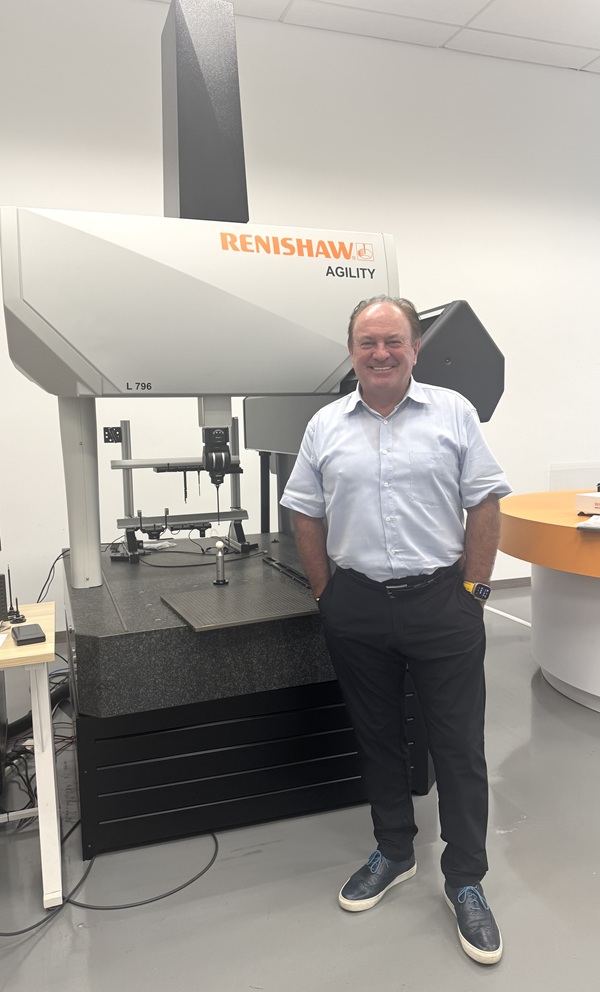
In today’s dynamic business environment, manufacturers across Asia face the dual challenge of intense global competition and the need to cater to increasingly diverse applications. According to Steve Bell, General Manager for Renishaw ASEAN, in an interview by International Metalworking News for Asia, the key to staying competitive lies in producing parts quickly, efficiently, and to the highest quality standards.
“Regardless
of the industry, the goals never really change—manufacturers aim to make parts
that meet strict quality requirements, are delivered efficiently, and remain
attractive to customers,” Bell explains. “Automation is an enabler for all
these objectives. It delivers process consistency, reduces errors caused by
human variability, and helps eliminate scrap and rework, ultimately driving
efficiency and customer satisfaction.”
Bell
also notes that this shift toward automation is not simply about keeping pace
with competitors—it is about securing a sustainable operational model in an
industry where margins are tight and expectations are rising.
The
Power of Machine Tool Probing
For
Renishaw, automation in machining goes far beyond robotics and material
handling. Bell emphasizes that one of the most impactful areas is machine tool
probing, which streamlines essential yet traditionally time-consuming tasks
such as tool setup and part alignment.
“Before
cutting begins, setting up tools and parts manually can be labour-intensive and
prone to errors,” he says. “With tool setters and machine tool probing,
manufacturers can automate these steps, accurately orient the part, and ensure
the correct configuration before machining starts. Even without using probes
inspection purposes, simply using them to set up the part delivers immediate
benefits in accuracy and efficiency.”
These
advantages extend into using probes in-process to automatically update tool
offsets. By tracking dimensional changes due to factors such as temperature fluctuation
or tool wear, Renishaw’s systems can make real-time adjustments to maintain
part accuracy, reducing the risk of producing defective components. Over time,
this not only improves consistency but also reduces production costs and helps
manufacturers take on more complex, higher-value work.
Overcoming
Perceptions of Complexity and Cost
A
common perception among small and medium-sized enterprises (SMEs) is that
automation is prohibitively expensive or overly complex. Bell believes this
view is shifting.
“Automation
today is far more accessible than it was a few years ago,” he notes. “The
return on investment can be swift, especially when the technology eliminates
rework, boosts throughput, and enhances part quality. Importantly, automation
isn’t one-size-fits-all—it can start with relatively simple steps like part
setup and tool setting, which already deliver significant gains.”
One
recent case involved an EV parts manufacturer struggling with high scrap rates
and inconsistent quality. By integrating Renishaw’s probing systems for both
initial part setup and in-process verification before final cuts, the company
virtually eliminated scrap, proving the tangible value of even modest
automation solutions.
Enabling
Smart Manufacturing and Industry 4.0
Machine
tool probing also plays a critical role in enabling broader smart factory and
Industry 4.0 strategies. Renishaw’s Central factory monitoring software uses
part-centric data—rather than just machine utilisation metrics—to track quality
in real time.
“In
unattended processes, our on-machine systems, by which I mean the machine tool
probe and tool setter, can automatically detect the tool wear and adjust offsets
to maintain accuracy without human intervention. Renishaw Central does this by
collecting and processing metrology data and monitoring the machine status
remotely,” Bell explains. “This approach empowers both the automation and the
people managing it to make timely, informed decisions. It’s not just about
running machines faster—it’s about running them smarter.”
Bell
highlights that the ability to gather and act upon live quality data is
becoming a non-negotiable requirement for manufacturers aiming to integrate
fully into modern supply chains, particularly in industries with zero-defect
expectations such as aerospace, medical devices, and electronics.
A
Solution for All Sizes of Operations
Bell
stresses that automation is not just for large multinational corporations.
Smaller workshops, even those with only a handful of machine tools, can see
significant benefits—especially when producing high-quality parts for
industries like aerospace or oil and gas.
“In
reality, making parts without these technologies is what’s truly difficult,” he
says. “Automation simplifies processes, reduces trial and error, and makes
switching between different production jobs much faster and more efficient.
Whether you’re making aerospace components one day and oil-and-gas parts the
next, our systems make that changeover smoother and less prone to costly
mistakes.”
Local
Support and Education in ASEAN
Renishaw’s
commitment to the ASEAN market extends beyond selling equipment. Bell
underscores that support is the company’s foundation—in new markets, the first
hires are always support engineers, not salespeople.
“Because
Renishaw is also a manufacturer, we use the same technologies in our own
operations. That gives us unparalleled depth and breadth of experience across manufacturing
processes,” he says. “We place a strong emphasis on educating customers,
especially in regions that are still developing their industrial capabilities.
Some clients know exactly how they want to implement our technologies, while
others need guidance on best practices. We’re ready to help both.”
Education,
he adds, is not a one-time event but an ongoing partnership. From training
sessions and workshops to hands-on demonstrations on the customer’s shop floor,
Renishaw ensures that its solutions are not just installed but fully integrated
into the customer’s workflow.
Looking
Ahead
As
manufacturing demands continue to evolve toward faster, more accurate, and more
efficient production, Renishaw remains committed to refining its products and
introducing new solutions.
“Our
mission is to keep delivering technologies that simplify processes, enhance
quality, and provide measurable value,” Bell concludes. “Whether for a small
workshop or a global enterprise, the benefits of automation speak for
themselves. The companies that embrace it today will be the ones setting the
pace for the industry tomorrow.”
 |
By:
Kathryn Gerardino-Elagio
At
this year’s Siemens Realize LIVE, International Metalworking News for Asia
sat down with Suzanne Kopcha, Vice President of Strategy at Siemens Digital
Industries Software, for an exclusive conversation on the future of
manufacturing. With sustainability, open ecosystems, and digital transformation
dominating the industrial agenda, Kopcha offered a deep strategic lens into how
Siemens is not only empowering manufacturers to meet global environmental goals
but also redefining what’s possible in the era of Industry 4.0.
From
leveraging AI and lifecycle intelligence to driving co-innovation through open
partnerships, Kopcha’s insights reveal how Siemens is preparing for 2030 and
beyond—where everything from automation to innovation will be software-defined,
sustainable, and interconnected.
IMNA:
Siemens emphasises designing
sustainability into every phase of a product’s lifecycle. From your strategic
perspective, how are customers using Siemens solutions to meet global
sustainability goals while still maintaining competitiveness?
Absolutely—this
is a timely conversation. Just today, Siemens announced the next phase of our
sustainability strategy under the DEGREE framework, led by Judith Wiese, our
Managing Board Member for Sustainability.
While
sustainability is now a top priority for many, Siemens has embedded it in our
digital enterprise and digital twin solutions for over 20 years—enabling
efficiency through lightweighting, better manufacturability, and optimised
performance.
Customers
use tools like NX, generative AI, and our simulation and SaaS platforms to
reduce material waste and energy use. Solutions like Tecnomatix support the
design of energy-efficient processes, and we’re now even optimising entire
manufacturing facilities.
We’ve
also partnered with Salesforce to extend these capabilities into service, and
our integrated material management helps customers source local materials,
reducing emissions. In the process industry, our Enterprise Recipe Management
helps make supply chains more sustainable.
Beyond
tools, we’re investing in people. Our partnership with ABET helps certify
future-ready curricula. One major aerospace company now only hires CAD
engineers with the NX credential—a testament to its impact.
Looking
ahead, we’ll launch an (Life Cycle Assessment) LCA solution with Makersite in
late 2025 through Teamcenter, giving customers visibility into the carbon
footprint across a product’s lifecycle—helping them design with sustainability
in mind from the start.
IMNA:
How is Siemens shaping its strategic
priorities to support manufacturers across diverse sectors in transitioning
toward Industry 4.0, especially in markets that are still early in digital
transformation?
I’ll
speak broadly from a Siemens-level perspective. As a company, we’ve made very
public commitments to sustainability—including aggressive targets to become
carbon neutral across all our manufacturing facilities globally. We've built
in-house capabilities and partnered with industry to define standards for
measuring carbon footprints within our operations.
On
the software side, we were one of the founding members of the Green Software
Foundation, alongside Accenture, Microsoft, and other major tech players. This
group works to define sustainability standards for software, which is
increasingly important as SaaS and AI workloads grow and data centers consume
more energy. We’re now designing our software to minimise compute resource
demands—a key consideration as AI use scales up.
So
we’re embedding sustainability not only in products we provide to customers,
but in our internal operations and technology strategy.
IMNA:
With ecosystems becoming more
interconnected, how is Siemens supporting strategic partnerships or open
ecosystems to help customers co-innovate and drive faster product development?
To
be honest, open ecosystems are at the core of everything we do. In the past, we
talked about the three pillars of our strategy: comprehensive digital twin,
open ecosystem, and modern/adaptable solutions. Eventually, we stopped labeling
“open ecosystem” as a differentiator—because it’s no longer optional. It's a
must.
We
collaborate with a broad range of partners: IBM, Microsoft, AWS, NVIDIA—you
name it. Whether it’s industrial metaverse initiatives or Teamcenter
integrations, we work hand-in-hand with our partners. For instance, we’ve
recently deepened collaboration with Accenture, who created a dedicated Siemens
business unit because of the strength of our partnership.
This
co-innovation model is key. With many customers, we form a three-way
collaboration: Siemens, the customer, and a partner—all working together to
drive innovation. Different industries require different strategic partners,
and we structure these relationships accordingly.
Unfortunately,
not all players share this mindset. Some of our competitors still maintain
closed ecosystems and refuse to provide API access—even when major joint
customers are requesting it. That’s not sustainable in today’s world. Customers
expect openness and integration, and we fully embrace that.
Within
my corporate strategy role, I oversee our portfolio planning, including
decisions on what we build, buy, or partner for. We've mapped out domains where
we consciously avoid acquisitions—not because we can’t invest, but because our
partners are already world-class in those areas. That frees us to focus on
building uniquely differentiated capabilities for Siemens.
Open
collaboration is baked into our DNA—it’s not just a strategy; it’s how we work
every day.
IMNA:
Looking ahead, what strategic trends or
disruptions do you believe will redefine industrial digitalisation by 2030—and
how is Siemens preparing to lead through those changes?
Two
major trends are set to reshape the future: software-defined everything and
lifecycle intelligence.
The
shift to software-defined systems is transforming automation—moving from rigid
black-box hardware to flexible, software-driven solutions. This evolution blurs
the lines between PLM, EDA, and software engineering, demanding new approaches
to systems design, updates, and lifecycle validation.
I
prefer the term “lifecycle intelligence” over simply “AI” because it
encompasses data quality, AI, and the industrial metaverse. It’s not just about
visuals—it’s about deeply integrated, contextual data enabling smarter, more
sustainable decisions across the product lifecycle.
AI
won't replace humans, but it will amplify human intelligence. Combined with
unified data and automated workflows, it will unlock new levels of productivity
and innovation—potentially even solving global challenges.
Siemens
has long anticipated this shift. Our acquisition of Mentor Graphics years ago
positioned us well, and we’re now doubling down with focused investment
strategies in these areas. Expect to hear more soon—what’s coming could be
industry-defining.

A Strategic Gathering in Cikarang
Cikarang is one of Indonesia’s most important industrial hubs, home to major automotive and manufacturing players. By choosing the Nuanza Hotel as the venue, the summit offers a professional and accessible platform where manufacturers, suppliers, and technology innovators can engage in both structured sessions and networking opportunities.
Organized by Ringier Trade Media Ltd.
With decades of experience delivering high-level conferences across Asia, Ringier Trade Media Ltd. is committed to curating meaningful platforms where industry stakeholders can share insights and explore future opportunities. The company’s expertise ensures the summit will deliver high-value content while also facilitating connections between businesses, associations, and technology providers.
Association & Business Partners
The 2025 summit has the strong support of leading organizations. The Indonesian Automotive Parts & Components Industries Association (GIAMM) and the Indonesian ISO Expert Association (IIEA) are official association partners, reinforcing the summit’s credibility and relevance for local industry stakeholders.
Business partners Jainnher Machine Co., Ltd., a leader in precision grinding machines, and Jiaxing Daomo Engineering Plastics Co., Ltd., a developer of engineered plastics solutions, will also bring valuable expertise and showcase technologies that address evolving industry needs.
Confirmed Speakers and Topics
A distinguished line-up of confirmed speakers will share perspectives on manufacturing flexibility, EV adoption, and sustainable automotive practices:
Mr. Kukuh Kumara, Secretary-General, Association of Indonesia Automotive Industries (GAIKINDO)
Looking Ahead
As flexible production becomes a cornerstone of competitiveness and EV solutions redefine the automotive supply chain, this summit offers timely insights for companies navigating rapid transformation. Delegates will gain access to strategic perspectives, innovative technologies, and valuable networking opportunities.
By bringing together associations, business leaders, and technology innovators under the organization of Ringier Trade Media Ltd., the 2025 ASEAN Advanced Automotive Manufacturing Summit will serve as a key platform to accelerate collaboration and position ASEAN as a driver of next-generation automotive manufacturing.
REGISTER NOW: https://forms.office.com/r/Ftsy3YNQ2B
📅 May 14, 2025 | 🕘 9:00 AM – 1:00 PM
📍 The Grand Fourwings Convention Hotel, Bangkok
Step into the future of smart manufacturing and Industry 4.0 at this exclusive high-level forum!
Hear from industry leaders like Dr. Prapin Abhinorasaeth (President, Thai Automation and Robotics Association) and Mr. Chodnarin Vipada (Secretary-General, Thai PDA) as they reveal strategies driving China–Thailand industrial cooperation.


🔹 Explore cutting-edge innovations
🔹 Unlock cross-border investment opportunities
🔹 Accelerate your digital transformation journey
🎯 Hosted by CCCME | Operated by Ringier Events
🎁 Bonus: Special giveaway for early arrivals!
👉 Register now: https://forms.gle/BYRqQZz2FVGoYbPw9
Blaser Swisslube, South-East Asia celebrated customer success by hosting Productivity Trophy 2025 at Vietnam on March 21, 2025. Winners were declared across 5 categories. The winner companies have demonstrated how Blaser’s Liquid Tool has helped them to achieve notable improvements in their machining processes.
Winners of Productivity Trophy 2025:
Tool Optimization – PT. Asia Express Solusi (Indonesia)
Productivity Increase – PT. Cahaya Sukses Mandiri (Indonesia)
Total Cost of Ownership – 29 Mechanical One Member Co., Ltd (Vietnam)
Process Optimization – UMS (Singapore)
Sustainability – Kinergy (Philippines)
Congratulations to all the winners driving success and innovation across South East Asia!
Vietnam’s
Manufacturing Momentum: Highlights from the 2025 ASEAN High-Performance
Machining Summit
By:
Kathryn Gerardino-Elagio, Ringier Trade Media Ltd

The 2025
ASEAN High-Performance Machining Summit, organised by Ringier Trade
Media Ltd’s Ringier Event Southeast Asia, concluded successfully on April 2
with factory tours to Denso Manufacturing Vietnam Co., Ltd and Export
Mechanical Tools Joint Stock Company (EMTC). The two-day summit drew
participation from business partners across China, Taiwan, Singapore, and Malaysia,
along with participants from India, Hong Kong, and other ASEAN nations — all
converging to better understand Vietnam’s evolving role in the global
manufacturing value chain.
Vietnam’s
Path to Global Manufacturing Competitiveness
The
summit, held in Hanoi, served as a platform for experts to share how Vietnam is
positioning itself as a hub for automotive components, electronics, and
advanced automation technologies. As the country climbs the value chain,
its journey reflects both its industrial resilience and its ambitious digital
transformation goals.
One
of the most insightful sessions came from Ms. Do Thi Thuy Huong,
Executive Board Member of the Vietnam Electronic Industries Association
(VEIA). She highlighted:
She
also referenced the Vietnam Smart Manufacturing Market, projected to grow at a
CAGR of 11.2% from 2024 to 2032, fuelled by the National Digital Transformation
Program and high-tech zones like Hoa Lac and Saigon High-Tech Park.

Ms.
Pham Hoai Anh, CCO
of 1C Vietnam and representative of the Hanoi Association of Main Industries
(HAMI), presented an in-depth view of digital transformation efforts in
Vietnam’s motorcycle and automotive parts manufacturing. Her keynote aligned
with recent data showing Vietnam's strong performance in auto parts exports:
Vietnam
now ranks 3rd globally in automotive wiring component exports, following China
and India — reinforcing its growing influence in the automotive supply
ecosystem.
From
Lean to Lighthouse: A Framework for Sustainable Manufacturing
Another
compelling presentation came from Mr. Pham Minh Thang, Vice President of the
Vietnam Association of Supporting Industries (VASI) and CEO of P&Q
Solutions
He
introduced VASI’s “Lighthouse Manufacturing” initiative — an integrated model
for sustainable and digitally empowered manufacturing excellence.
Key
points included:
He
emphasised a collaborative network involving research bodies, tech providers,
and industry players to push for systemic transformation.

Several
technical presentations also enriched the summit’s agenda:
Wrapping
Up with Real-World Insights
The
final day featured exclusive factory tours to Denso Manufacturing Vietnam Co.,
Ltd and EMTC, offering delegates a firsthand look at Vietnamese manufacturing
in action. These visits not only showcased technical capabilities but also
illustrated how global partnerships and local expertise are blending in
Vietnam’s industrial landscape.
Final
Thoughts
The
2025 ASEAN High-Performance Machining Summit offered more than just expert
talks and factory visits — it provided a real-time snapshot of Vietnam’s
dynamic transformation. No longer just a destination for low-cost assembly,
Vietnam is steadily shaping its identity as a forward-thinking,
innovation-driven manufacturing hub.
From
government-backed digitalisation programs to increasing adoption of smart
manufacturing practices, the country is building the foundations to lead
Southeast Asia in high-performance machining and industrial automation. The
summit brought together thought leaders, manufacturers, and solution providers
who are not only adapting to these changes — they’re helping drive them.
What
stood out most was the openness and enthusiasm for collaboration. Participants
from China, Taiwan, Singapore, Malaysia, India, and beyond had the opportunity
to exchange ideas and forge connections with Vietnamese companies, local
industry associations, and policy influencers. Whether you’re a business
seeking regional partnerships, a solutions provider looking for market
expansion, or an industrial leader exploring what's next, Vietnam offers a
compelling story — and the ASEAN High-Performance Machining Summit is where
that story unfolds.
As
the summit concluded with real-world factory insights and cross-border
conversations, it became clear: the groundwork is being laid now for long-term
success. For companies invested in the future of precision manufacturing and
sustainable growth in Asia, this is the moment to engage.
We
look forward to welcoming more partners, innovators, and regional leaders to
the next edition of the summit. Your next opportunity to be part of Vietnam’s
industrial journey starts here.
In today's fast-paced design world, manufacturers need to create innovative products quickly and efficiently. Coupled with the digital twin, Mechatronics Concept Designer (MCD) accelerates product development, improves design quality, and reduces integration issues.
MCD supports the entire design process, from conceptual design through to machine commissioning, allowing design validation, rapid changes and lower costs across all development stages and between different departments. By integrating software and hardware domains, MCD helps to dramatically reduce time-to- market.
Join this webinar to discover how NX Mechatronics Concept Designer (NX MCD) and the digital twin can transform your workflow. NX MCD enables mechanical, electrical, and automation engineers to collaborate seamlessly, enhancing communication and efficiency.
Webinar Date: Wed, February 12, 2025
Time: 9.30 am MYT and SGT
Key Benefits for You:
• Seamless Integration: Move from design to manufacturing planning in one platform.
• Robust Simulation: Validate your concepts before production.
• Increased Productivity: Use the latest NX MCD updates to boost efficiency.
https://us06web.zoom.us/webinar/register/2017295656493/WN_qAH95-mcSmu_IJ47rsHwSg


